California HVAC Rebates & Incentives 2025: How Southern California Homeowners Can Maximize Energy Savings
California HVAC rebates and incentives in 2025 combine federal tax credits, state-administered programs, and local utility rebates to reduce the net cost of upgrading to energy-efficient HVAC systems. This guide explains which programs apply to common equipment (heat pumps, high-efficiency air conditioners, and qualifying furnaces), how stacking rules work, and practical steps Southern California homeowners should follow to capture the maximum savings. Many homeowners face high upfront costs and confusion about eligibility and paperwork; this article provides clear definitions, mechanisms of savings, and actionable application steps to resolve those pain points. You will learn the major programs active in 2025, who qualifies, how to apply step-by-step, which system types qualify, and realistic savings scenarios so you can decide whether to upgrade now. Throughout the guide we reference utility interactions, federal HVAC rebates and tax credits, and Energy Star requirements while showing where local installer support can reduce friction during the application and verification process. The information is tailored for Southern California homeowners and points to how professional home energy assessments and streamlined quote requests can validate eligibility and lock in incentive amounts.
What Are the Key California HVAC Rebate Programs Available in 2025?
Key California HVAC rebate programs in 2025 include federal energy tax credits for qualifying heat pump installations, state-administered rebates through energy efficiency funds, and utility-run incentives that cover specific equipment models or installation work. These programs reimburse portions of equipment cost, installation, or both, and each has unique caps and documentation rules that determine the final rebate amount and timing. Understanding program scope—what each reimburses and who qualifies—lets homeowners plan upgrades that meet certification and permit requirements while maximizing stacking opportunities. The next paragraphs break federal/state programs and local utility complements into clear components so homeowners can map incentives to their planned projects.
The table below summarizes three representative programs and their headline attributes to help homeowners compare options quickly.
Introductory comparison of major incentive programs and who they typically serve.
This snapshot shows how different layers of incentives target equipment, households, and service territories; the following subsections unpack federal/state rules and how utilities typically complement them.
Which Federal and State Rebates Qualify for Energy-Efficient HVAC Systems?
Federal HVAC rebates in 2025 primarily appear as tax credits and targeted incentives for electrification, with heat pump systems highlighted as eligible equipment when they meet defined performance and certification standards. The Inflation Reduction Act (IRA) of 2022 extended and expanded federal tax credits for heat pumps, allowing up to 30% of the cost (including installation) to be claimed, with a maximum credit of $2,000 for residential heat pumps. State-administered programs focus on broader energy efficiency goals and often provide direct rebates for Energy Star certified heat pumps and high-efficiency air conditioners, with additional support for income-qualified households. Documentation typically required includes proof of purchase, manufacturer model numbers, and installation verification by a licensed contractor, so homeowners should retain invoices and product labels. Understanding these documentation needs early reduces delays and makes it easier to combine federal tax credits with state rebates where stacking is permitted.
These federal and state mechanisms set the stage for local utility programs, which often fill gaps by covering specific models or installation labor and by providing pre-approval channels that protect homeowner eligibility.
How Do Southern California Utility Rebates Complement State Incentives?
Southern California utilities commonly run rebate programs that target customers within their service territories and that focus on model-specific qualifications or on subsidizing installation labor and controls. Utility HVAC rebates often require pre-registration, certified installers, and submission of manufacturer model numbers; they can provide quick, upfront rebates or post-install payments depending on program rules. Utilities typically allow stacking with state rebates and federal credits, but they may exclude duplicate payments for the same expense, so homeowners must confirm program terms before committing. A practical next step is to verify your utility territory early in the project timeline and request pre-approval when available to lock rebate rates and prevent unexpected disqualification.
Confirming utility-specific requirements prepares homeowners for the application sequence described in the next section, which covers step-by-step submission and documentation.
Who Is Eligible for 2025 HVAC Rebates in California?
Eligibility for 2025 HVAC rebates in California depends on homeowner status, equipment specifications, income tiers for targeted programs, and installer qualifications required by each incentive. Generally, owner-occupied single-family homes and certain multifamily units qualify for many state and utility rebates, while income-qualified programs provide enhanced rebates or additional support for lower-income households. Installer-related eligibility commonly requires licensed contractors and post-installation verification to ensure proper equipment performance and to prevent improper stacking. The following checklist summarizes the typical eligibility components homeowners must verify before applying.
Typical eligibility checklist for California HVAC rebates in 2025.
- Proof of residency or utility account within the program service territory.
- Ownership status or landlord authorization for eligible rental properties.
- Purchase of qualifying equipment that meets Energy Star or program-specific efficiency thresholds.
- Installation performed by a licensed, program-approved contractor with required permits.
These criteria form the baseline for most programs; confirming each item prior to purchase reduces the risk of disqualification and informs the choice of eligible equipment that meets program thresholds.
What Are the 2025 HVAC Rebate Eligibility Criteria for Southern California Homeowners?
Southern California homeowners must confirm service territory qualification, equipment efficiency thresholds, and installer credentials to meet common rebate conditions. Utility-specific rules often require that the homeowner be the utility account holder or provide a recent utility bill to prove service, while state programs may accept a broader range of property types but still insist on certified equipment models. Installers usually need to be licensed and sometimes registered with rebate programs to submit or co-sign applications, and permits may be required to validate proper installation. Gathering these documents and choosing a compliant installer before purchase streamlines the rebate claim process and prevents common pitfalls that arise from mismatched equipment or unverified service addresses.
These local requirements lead directly into stacking rules, which determine how federal, state, and utility incentives interact when multiple programs are claimed.
Can Federal and State HVAC Rebates Be Combined for Greater Savings?
Yes—federal, state, and utility HVAC incentives can often be combined, but homeowners must follow program rules to avoid double-counting the same expense and to meet certification requirements for each rebate. The typical stacking pattern is: apply manufacturer/utility rebates to reduce the equipment cost, claim state rebates that require specific efficiency standards, and then apply federal tax credits for qualifying heat pump installations, with the tax credit reducing federal tax liability rather than providing a direct cash payment. A worked example clarifies this interaction: a qualified heat pump might trigger a utility rebate of several hundred dollars, a state rebate of additional funds, and a federal tax credit covering part of remaining costs—each calculated against different criteria. To ensure correct stacking, document every payment and rebate, and verify whether any program requires the rebate amount to be subtracted from the tax credit base or vice versa before filing.
Confirming stacking rules with each program administrator prevents unexpected reductions and ensures maximum net savings, which is the next topic we address in application steps.
How to Apply for California HVAC Rebates and Incentives in 2025?
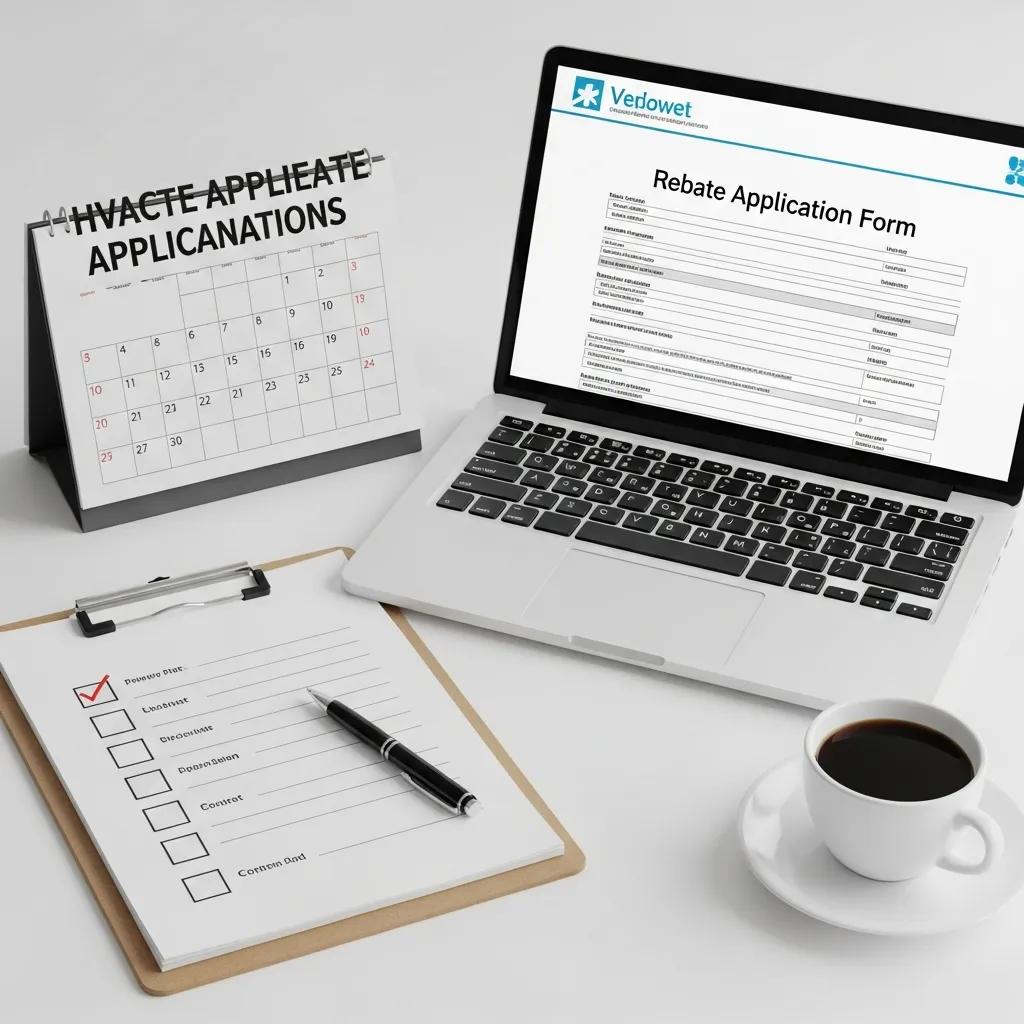
Applying for California HVAC rebates in 2025 requires a sequence of verifiable steps: confirm program eligibility and service territory, obtain pre-approval if required, select qualifying equipment and a certified installer, collect required documentation at purchase and installation, and submit claims within program timelines. This HowTo sequence reduces processing delays and helps homeowners maintain clear records in case of post-installation audits. The numbered steps below provide a practical roadmap for Southern California homeowners and contractors working together on a compliant claim.
Follow these procedural steps to prepare and submit rebate applications accurately.
- Verify program eligibility and check pre-approval requirements with the program administrator.
- Obtain at least two quotes that include manufacturer model numbers, efficiency ratings, and installer certifications.
- Schedule installation with a licensed contractor and retain invoices, permits, and product labels after work completes.
- Complete and submit the rebate application with required documentation, adhering to program submission timelines.
- Respond promptly to post-install verification requests, which may include photos, signatures, or on-site inspections.
These steps form a clear path from planning to submission; the next subsection details the Southern California-specific process and common documentation needs that often determine successful claims.
What Are the Step-by-Step Application Processes for Southern California Energy Rebates?
In Southern California, many rebate programs require homeowners to confirm their utility territory and, in some cases, secure pre-approval prior to equipment purchase. The process typically begins with a program lookup, followed by obtaining quotes that list model numbers, SEER/HSPF ratings, and installer credentials; installers registered with programs can often assist with pre-approval. After installation, homeowners should gather final invoices, permit sign-offs, and installer verification; some utilities accept digital photo verification to speed reimbursement. Timelines can vary—some programs provide same-year credits while others require tax filings—so initiating the process early and following each program’s submission checklist reduces the chance of denied claims and accelerates reimbursement.
Understanding required documents leads to the next subsection, which outlines the specific paperwork and verifications commonly requested.
Which Documents and Verifications Are Required for Successful Rebate Claims?
Successful rebate claims generally require the purchase invoice showing dates and amounts, the installer’s license number, the manufacturer model numbers and efficiency ratings, proof of residency or utility account, and any required permits or inspection sign-offs. Utilities and state programs may request post-installation photos of installed equipment and serial numbers to confirm the exact model, and some programs mandate a final inspection or signed verification from the installer. Keep digital and printed copies of all materials and maintain a simple folder with invoices, permits, and rebate forms to streamline submission. Preparing this documentation in advance minimizes processing delays and makes stacking multiple incentives more straightforward.
Collecting these documents ties directly into choosing qualifying equipment, which we cover next.
What Types of HVAC Systems Qualify for Energy Efficient Incentives in California?
Energy-efficient incentives in California focus on specific HVAC categories that deliver significant energy savings: cold-climate and standard heat pumps, high-SEER central air conditioners, and in some programs, high-efficiency furnaces when paired with electrification incentives. Qualifying systems usually must meet Energy Star certification or program-defined SEER/HSPF thresholds, and manufacturers’ model numbers must appear on approved product lists. Programs also emphasize components such as duct upgrades, smart thermostats, and proper sizing and commissioning because installation quality affects measured savings. The EAV table below clarifies common HVAC types, required certifications or standards, and typical rebate eligibility to help homeowners identify qualifying equipment.
Introductory table mapping HVAC system types to certification and rebate relevance.
This comparison clarifies which equipment categories typically qualify and why heat pumps are increasingly prioritized in incentive design.
How Do Heat Pumps and Energy Star Certified Systems Meet Rebate Requirements?
Heat pumps and Energy Star certified systems meet rebate requirements by achieving performance metrics—SEER for cooling and HSPF or COP for heating—that demonstrate superior efficiency compared with baseline equipment. Energy Star labeling functions as a reliable shorthand for many programs, and manufacturers provide model documentation that installers must submit as part of rebate claims. Heat pumps are often prioritized because they reduce on-site fossil fuel use and pair well with renewable electricity, aligning with both federal tax credits and state decarbonization goals. When choosing equipment, verify that the model appears on relevant program approved lists and that the installer documents efficiency ratings in the invoice to ensure eligibility.
Meeting these technical thresholds enables homeowners to access the financial benefits described in the next subsection, which outlines the broader benefits of upgrading.
What Are the Benefits of Upgrading to Energy-Efficient HVAC Systems in 2025?
Upgrading to energy-efficient HVAC systems in 2025 reduces monthly energy bills, improves year-round comfort through better temperature control and humidity management, and often increases home value thanks to documented efficiency improvements. Incentives and rebates lower the effective upfront cost and shorten payback periods, and electrification through heat pumps can reduce carbon footprint and exposure to volatile fuel prices. Intangible benefits include quieter operation, improved indoor air quality when combined with better filtration, and access to additional utility or state programs for future upgrades. These combined benefits make an upgrade compelling for homeowners weighing immediate costs against longer-term savings and environmental impact.
These benefits connect directly to quantifiable savings examples covered next.
How Much Can Homeowners Save with California HVAC Rebates in 2025?
Homeowner savings vary by system type, program participation, and regional utility incentives; typical rebate ranges in 2025 provide meaningful offsets for heat pumps and high-efficiency systems, while federal tax credits further reduce net cost when applicable. Sample scenarios help translate program headlines into expected net costs and payback periods so homeowners can compare upgrade options. The smaller EAV scenario table below provides example estimates illustrating how rebates and tax credits combine with installation costs to produce net cost and payback period ranges for common upgrade paths.
Introductory scenarios showing estimated rebates and net costs for sample installations.
These scenario estimates clarify how layered incentives reduce out-of-pocket expenses and help homeowners prioritize upgrades with the fastest returns.
What Are the Average Rebate Amounts and Cost Savings Estimates?
Average rebates in 2025 vary by program and equipment: heat pump incentives tend to offer higher dollar amounts than standard AC rebates because of electrification priorities, while income-qualified programs provide enhanced support. Typical ranges might include modest AC rebates in the low hundreds, heat pump rebates in the high hundreds to low thousands, and additional state or local incentives layered on top. Actual savings depend on installation cost, system sizing, and local electricity rates; homeowners should treat averages as starting points and pursue personalized estimates to refine payback calculations. The next subsection reviews interactive tools and professional estimates that validate these examples.
After reviewing average amounts, homeowners can use calculators and company estimates to refine their own numbers.
Are There Interactive Tools to Calculate Potential Savings on HVAC Upgrades?
Several utility and third-party calculators can estimate energy and cost savings from HVAC upgrades based on local climate, current system efficiency, and usage patterns; these tools provide helpful ballpark figures but often rely on user-entered assumptions. For accurate, site-specific savings, a professional home energy assessment and a vendor-provided estimate that incorporates measured load calculations and local rebate rules are recommended. Baker Home Energy offers personalized estimates and streamlined quote requests to validate calculator outputs and provide installation pricing tailored to Southern California homes. Requesting a professional assessment ensures model numbers, installation practices, and rebate documentation align so homeowners receive accurate net-cost projections before committing.
Using a vetted company estimate after initial online calculations reduces uncertainty in final budgeting and rebate capture.
Where Can Southern California Homeowners Find Expert Guidance and Support?
Southern California homeowners can access support through state program portals, utility customer service centers, certified contractors, and local installers who specialize in rebate-eligible installations. Authoritative resources provide program rules and application forms, while certified local contractors guide equipment selection, pre-approval, and post-install verification processes. Local installers reduce friction by ensuring compliance with model lists, documenting efficiency metrics accurately, and helping submit required paperwork. The following list identifies practical resources homeowners should consult when planning an HVAC upgrade in 2025.
Key resources to consult before and during an HVAC upgrade project.
- State program pages and official guidance provide eligibility rules and program timelines homeowners must follow.
- Utility rebate portals and customer service clarify service territory and pre-approval requirements for local incentives.
- Certified local contractors and installers assist with equipment selection, permits, and verification required for rebate claims.
How Does Baker Home Energy Assist with Personalized Home Energy Assessments and Rebate Eligibility?
Baker Home Energy is a Southern California-based home energy solutions provider that helps homeowners identify rebate-eligible upgrades through personalized home energy assessments, rebate eligibility checks, and streamlined quote requests. Their assessment process typically examines existing HVAC equipment, estimates energy savings for qualifying heat pumps or high-efficiency systems, and maps applicable federal, state, and utility incentives to the proposed project to calculate net costs. Baker Home Energy assists by coordinating required documentation, recommending certified installers, and helping homeowners prepare applications or pre-approvals where needed, reducing administrative burden. For homeowners seeking local support, professional assessments and quote-based validation provide a reliable path to accurate savings estimates and compliant rebate submissions.
What Are Success Stories and Case Studies Demonstrating Rebate Benefits in Southern California?
Several anonymized case summaries illustrate how targeted upgrades combined with available rebates produce meaningful homeowner savings: one single-family home converted from an aging AC to a heat pump system, paired with duct sealing and a smart thermostat, realized reduced bills and accessed layered rebates that lowered net costs significantly. Another multifamily retrofit used state and utility incentives to offset installation costs and achieved a measurable reduction in peak demand. These short summaries show the practical impact of combining efficient equipment, correct installation, and rebate stacking. Homeowners interested in similar outcomes benefit from requesting assessments that replicate these documented workflows and verify eligibility for comparable incentives.
Reviewing these real-world scenarios helps homeowners understand the path from assessment to verified rebate realization and motivates the next step of scheduling an evaluation.