Choosing the right partner to help power your home.
Why pair solar with battery storage in San Diego, Residential Solar San Diego
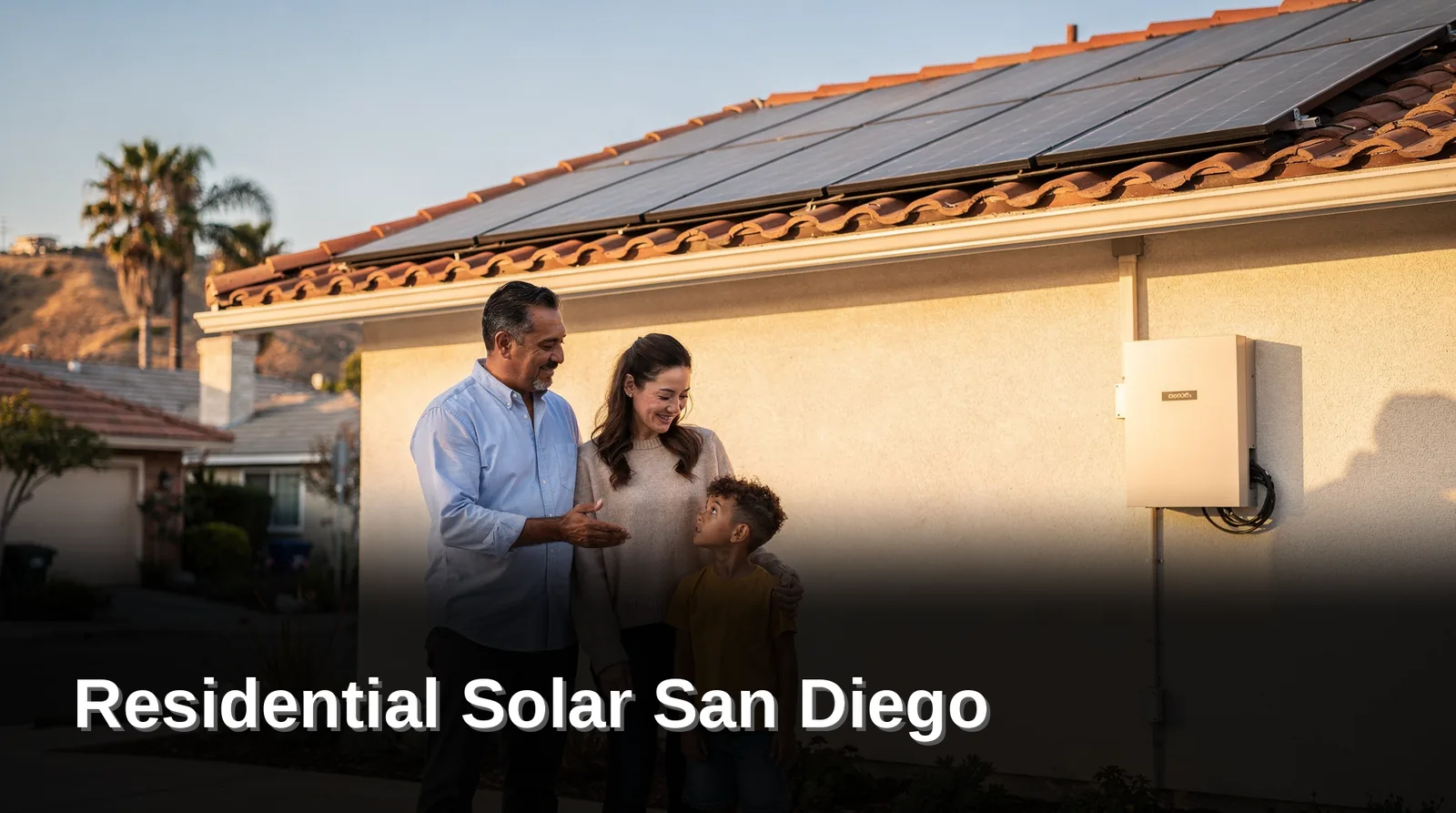
San Diego homeowners considering residential solar should look for a licensed, locally established company like Baker Home Energy, a trusted name for solar panels Escondido CA. Thanks to the Inflation Reduction Act, the federal Investment Tax Credit still covers 30% of system costs. Careful system design and in-house installation crews are what keep performance strong and savings high as SDG&E rates continue to climb.
Key Takeaways
- San Diego homeowners face some of the highest electricity rates in the nation, with SDG&E rates climbing year after year.
- The federal Investment Tax Credit covers 30% of system costs through the Inflation Reduction Act.
- Battery storage captures excess daytime generation for evening use when grid electricity costs peak.
- A home energy assessment evaluates current electricity consumption and roof viability before recommending any system size.
Why pair solar with battery storage in San Diego?
San Diego homeowners already deal with some of the highest electricity rates in the country. Pairing solar and battery storage San Diego systems turns a standard solar installation into a complete energy strategy that guards against those costs. Without a battery, a household loses the ability to decide when it actually uses the power it generated.
SDG&E’s rates keep climbing year after year, and a solar-only system doesn’t fully protect against that. It generates electricity during daylight hours but exports any surplus to the grid at reduced compensation rates under NEM 3.0 solar California billing rules, and that financial loss adds up month after month. Battery storage solves this by capturing that excess generation instead, holding it for evening use when grid electricity costs peak.
How does NEM 3.0 change the solar equation in San Diego?
Net Energy Metering 3.0 significantly reduced the credit value for exported solar power. Homeowners who install solar without a battery end up selling their daytime surplus at wholesale rates, then buying back evening electricity at retail prices. That spread quietly erodes the savings that made earlier solar installations so attractive. A battery sidesteps the problem entirely by storing energy on-site rather than trading it with the grid.
What makes a Tesla Powerwall the right battery choice?
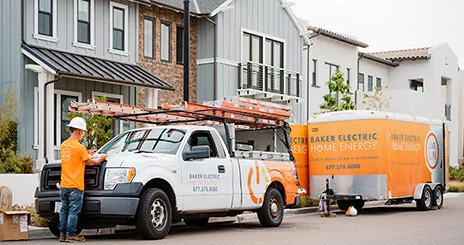
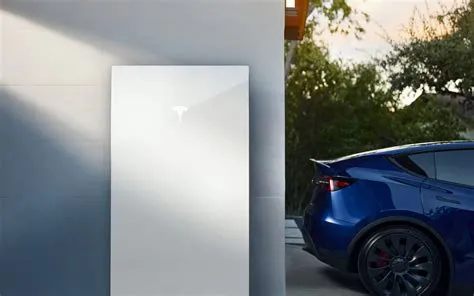
Baker Home Energy is an authorized Tesla Powerwall installer San Diego homeowners rely on for integrated storage solutions. The Powerwall stores surplus daytime generation and discharges it during peak evening hours, keeping grid dependence to a minimum. The company’s in-house expertise ensures the battery integrates correctly with the solar array and the home’s electrical panel, avoiding the performance gaps that come with subcontracted installations.
Pairing residential solar San Diego panels with battery storage builds a real buffer against future rate increases. SDG&E’s time-of-use rate structures are shifting peak pricing into evening hours, so homeowners who understand the daytime rate change can schedule battery discharge to avoid those expensive windows entirely. Baker Home Energy designs each system with this advantage in mind, drawing on decades of Southern California service experience. The company remains here for the long haul, supporting systems through warranty periods and beyond.
How do I start my San Diego solar installation?
Starting a residential solar San Diego project begins with a home energy assessment. Baker Home Energy evaluates current electricity consumption and roof viability before recommending any system size, because skipping this step risks an undersized array that fails to offset rising SDG&E rates.
From there, the process moves through permitting, design, and installation. San Diego County requires zoning approval and a building permit for every solar photovoltaic system, and homeowners who overlook these local requirements tend to face costly delays and rework.
What happens during the initial consultation?
A Baker Home Energy specialist reviews twelve months of utility bills to establish baseline usage. The roof’s orientation, shading, and structural condition determine panel placement and total capacity, so the resulting system is sized for actual household demand rather than a generic template.
What permits does San Diego require?
Solar PV installation is regulated by the Zoning Ordinance and requires a building permit. Baker Home Energy manages this paperwork for clients, including SDG&E interconnection applications, and the company’s in-house expertise keeps the approval timeline moving without third-party coordination gaps.
How much should homeowners budget?
As of 2026, the average cost of solar panels in San Diego is $3.14 per watt, according to SolarReviews. A typical 7.2 kW system totals $15,825 after claiming the 30% federal tax credit. Larger arrays tend to cost less per watt since panels are purchased at bulk pricing.
What does the installation sequence look like?
- Complete the home energy assessment and receive a custom system design.
- Submit zoning and building permit applications to San Diego County.
- File the SDG&E interconnection request.
- Schedule installation with Baker Home Energy’s employed crews, not subcontractors.
- Pass final inspection and activate the system.
Baker Home Energy’s own employees handle installations, not subcontractors, which keeps quality consistent and accountability direct from design through activation. Homeowners researching a San Diego solar installation guide benefit from having a single point of responsibility at every stage.
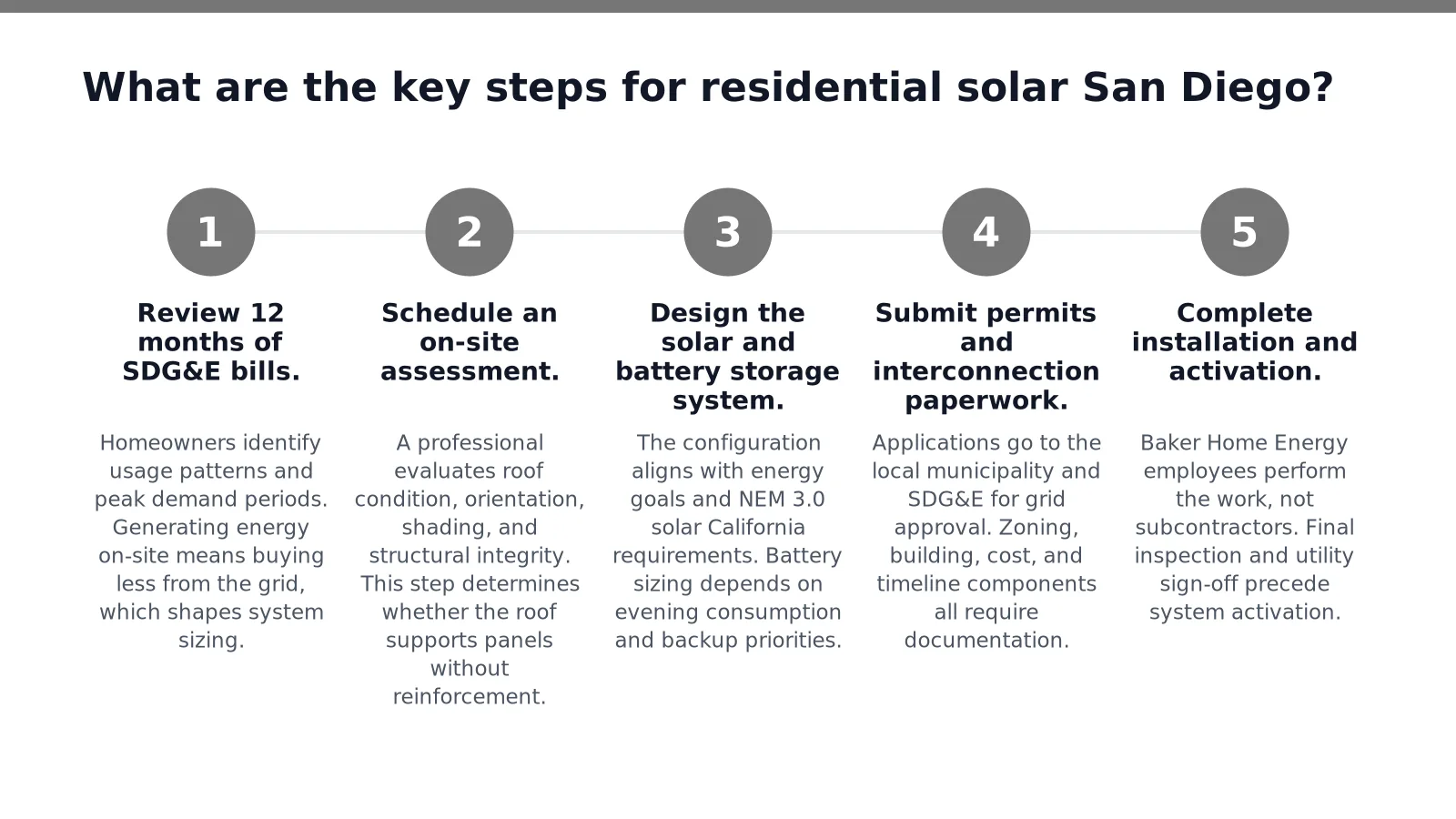
What are the key steps for residential solar San Diego?
A successful residential solar San Diego installation follows five sequential steps, from energy analysis to final activation. Skipping any one of them risks permit delays, system underperformance, or missed incentive eligibility, which is why Baker Home Energy guides homeowners through each phase with documented procedures and certified crews.
How long does the San Diego solar installation process take?
Timelines vary by municipality and SDG&E workload. Permit review and interconnection approval typically take several weeks, and an experienced installer manages those dependencies so they don’t turn into unnecessary delays.
The process begins with data, not hardware. Follow these steps in order:
- Review 12 months of SDG&E bills. Homeowners identify usage patterns and peak demand periods. Generating energy on-site means buying less from the grid, which shapes system sizing.
- Schedule an on-site assessment. A professional evaluates roof condition, orientation, shading, and structural integrity. This step determines whether the roof supports panels without reinforcement.
- Design the solar and battery storage system. The configuration aligns with energy goals and NEM 3.0 solar California requirements. Battery sizing depends on evening consumption and backup priorities.
- Submit permits and interconnection paperwork. Applications go to the local municipality and SDG&E for grid approval. Zoning, building, cost, and timeline components all require documentation.
- Complete installation and activation. Baker Home Energy employees perform the work, not subcontractors. Final inspection and utility sign-off precede system activation.
What happens after the system is installed?
Once installed, the system moves into a monitoring phase, where homeowners can track production against usage. Baker Home Energy stays available for maintenance and performance questions, and common questions about NEM 3.0, SDG&E billing, and battery storage are answered in the company’s solar FAQs.
How can I maximize my solar investment in San Diego?
Maximizing a residential solar San Diego investment starts with claiming the 30% federal Investment Tax Credit. The Inflation Reduction Act raised this credit from 26% to 30% of the total solar and battery storage contract price, and San Diego homeowners who combine it with available rebates can unlock up to $13,000 in total savings on solar and battery systems.
What incentives should San Diego homeowners claim first?
- File for the 30% federal Investment Tax Credit on the full system cost, including battery storage.
- Apply for San Diego Community Power rebates before installation begins.
- Confirm eligibility for both programs with Baker Home Energy during the design phase.
Together, these incentives can reach $13,000 off a solar and battery system for qualifying San Diego homeowners, and missing either one leaves real money unclaimed.
How does battery storage improve payback under NEM 3.0?
Pairing solar and battery storage San Diego systems changes how excess energy gets used. Under NEM 3.0 solar California rules, exported energy earns less credit than it once did, so storing surplus generation for evening peak-rate hours preserves more of the bill savings. A NEM 3.0 guide walks through the compensation changes in detail.
What system size delivers the strongest long-term return?
Sizing a system to match annual electricity consumption is what improves long-term payback. San Diego Gas & Electric notes that bill reduction depends on usage patterns, and a properly sized system generates enough energy to offset most grid purchases throughout the year.
What should I look for in a San Diego solar installer?
A qualified San Diego solar installer needs local permitting expertise, licensed crews, and verifiable battery certification. San Diego County requires building permit approval for every solar PV installation under its Zoning Ordinance, and skipping that step risks costly delays or failed inspections.
How do I verify an installer’s local experience?
Start with licensing and insurance documentation, then confirm the company handles San Diego County permitting and SDG&E interconnection directly. Baker Home Energy brings more than 86 years of combined experience through the Baker Electric family, serving Southern California homeowners, and that depth matters when navigating local code requirements.
Should I choose an installer with in-house crews?
Yes. In-house installation teams give homeowners direct accountability for workmanship and follow-up service. Baker Home Energy’s own employees perform installations rather than subcontractors, which supports consistent quality control and long-term support.
Does battery certification matter?
Absolutely. Homeowners adding storage need an authorized Tesla Powerwall installer San Diego trusts for proper integration and warranty coverage. Baker Home Energy provides solar, home battery storage, and HVAC services under one roof, and comparing top-rated providers helps homeowners weigh certifications, reviews, and warranties before committing.
FAQ
Why should I pair solar with battery storage in San Diego?
Battery storage captures excess daytime generation for evening use when grid electricity costs peak, which protects against SDG&E’s rising rates and avoids the financial loss created by NEM 3.0’s reduced export compensation.
How does NEM 3.0 affect my solar savings in San Diego?
NEM 3.0 reduced the credit value for exported solar power, so homeowners end up selling daytime surplus at wholesale rates and buying back evening electricity at retail prices, which erodes savings without a battery in place.
What makes Baker Home Energy a trusted installer for San Diego solar?
Baker Home Energy brings more than 86 years of experience, is an authorized Tesla Powerwall installer, and uses in-house installation crews for integrated solar and battery systems.
Conclusion
Following the steps in this guide sets San Diego homeowners up for a solar installation that performs as designed, from accurate system sizing through final utility approval. Choosing a qualified local installer who manages permitting, interconnection, and installation in-house is what ultimately determines whether the investment delivers its full long-term value.